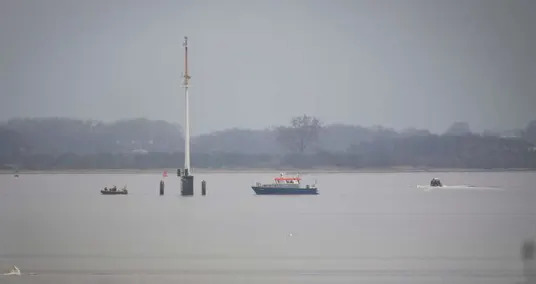
Divers have discovered a long-submerged wall some 7,000 years old under the sea off western France, scientists said Thursday.
Nearly 400 feet long, it was found off the Ile de Sein in Brittany along with a dozen smaller manmade structures from the same period.
"This is a very interesting discovery that opens up new prospects for underwater archaeology, helping us better understand how coastal societies were organized," Yvan Pailler, professor of archaeology at the University of Western Brittany, told AFP.
He co-authored a study on the find, published in the International Journal of Nautical Archaeology.
The structures were first spotted by retired geologist Yves Fouquet in 2017 on charts of the ocean floor produced with a laser system.
The wall is the biggest underwater construction ever found in France, BBC News reported.

Divers explored the site between 2022 and 2024 and confirmed the presence of the granite structures.
"Archaeologists did not expect to find such well-preserved structures in such a harsh setting," Fouquet said.
Dating from between 5,800 and 5,300 BC, they lie nine meters underwater and were built at a time when sea levels were much lower than today.
Researchers believe they may have been fish traps built on the foreshore, or walls to protect against rising seas.
The study says the structures reflect "technical skills and social organization sufficient to extract, move and erect blocks weighing several tons, similar in mass to many Breton megaliths," large stone arrangements used as monuments or for ceremonial purposes.
This technical know-how would predate the first megalithic constructions by several centuries.
The study's authors speculate the site may lie at the origin of local Breton legends of sunken cities, according to BBC News. One such lost city – Ys – was believed to lie in the Bay of Douarnenez, just a few miles to the east.
"It is likely that the abandonment of a territory developed by a highly structured society has become deeply rooted in people's memories," the study says. "The submersion caused by the rapid rise in sea level, followed by the abandonment of fishing structures, protective works, and habitation sites, must have left a lasting impression."
The discovery comes about six months after archaeologists found the remains of a 16th-century merchant ship more than 1.5 miles underwater off southern France, the deepest such find in the region.
Erika Kirk has one word for Candace Owens as she spreads conspiracy theories
Former Michigan football coach Sherrone Moore detained by police after firing
"Survivor" contestant on mission to prove his sister was murdered
latest_posts
- 1
 Vote In favor of Your Favored Kind Of Attire
 - 2Fossil analysis changes what paleontologists know about how long T. rex took to grow full size
- 3Israel’s 'Stonehenge’ not alone with near 30 similar sites, satellite imagery reveals
- 4Island Travel Guide: Must-Visit Objections for 2024
- 5Cells have more mini ‘organs’ than researchers thought − unbound by membranes, these rogue organelles challenge biology’s fundamentals




- Which Espresso Do You Like Best? Vote
- Doritos and Cheetos debut 'NKD' options, without artificial colors or flavors
- Instructions to Really Oversee Unsold SUVs in the Auto Business
- Find the Insider facts of Viable Advertising: Building a Positive Brand Picture
- Chemical leak in Oklahoma forces evacuations and leaves many ill
- Whale stranded off Germany for days free again
- Hamas set to elect new terror leader with Hayya, Mashaal in pole position
- Instructions to Keep up with Your Traded Teeth for Life span
- Find the Excellence of Old style Expressive dance: Encountering the Effortlessness and Polish of Dance